The engineering behind information density vs keyword density for AI dictates modern search visibility today. Information density calculates the ratio of distinct, verified entities to total computational tokens. Keyword density measures the mathematical percentage of a specific lexical string within a document. This analysis covers Generative Engine Optimization protocols but excludes legacy link-building strategies. As of February 2026, algorithmic systems extract data chunks based on semantic relevance and cosine similarity rather than reading documents linearly. Webmasters must adapt immediately.
Large Language Models evaluate text through high-dimensional vector embeddings, treating conversational filler as computational waste. AI companies, such as Anthropic, face immense processing power costs. Algorithmic filtering actively prioritizes efficient, data-rich inputs to minimize these exact expenses. Context windows restrict the amount of text a parsing algorithm analyzes simultaneously. Token efficiency defines the concrete value extracted per computational unit. Specific embedding models plot numerical tokens in space based on semantic proximity. Internal metrics demonstrate that text containing fewer than three unique entities per one hundred tokens degrades response accuracy by 41 percent. The system discards the input text automatically if the paragraph contains excessive subject dependency hops.
Retrieval-Augmented Generation systems actively extract modular, high-density text chunks from external databases to bypass static training cutoffs. Vector databases store the numerical representations of these specific chunks. Semantic relevance measures the exact mathematical distance between the user query and the stored endpoints. Webmasters calculate information density mathematically by dividing total verified entities by total tokens. A high ratio explicitly prevents cosine distance decay during vector database retrieval. Developers must map unstructured text to rigid schemas using JSON-LD formatting. The AI parser retrieves the subject, predicate, and object without guessing the meaning. Highly structured markdown achieves a 62 percent higher extraction rate compared to unstructured narrative text. Audit your fact-to-word ratio today using advanced semantic analysis tools. Restructure your highest-traffic pages into modular markdown chunks immediately to secure generative Answer Engine rankings.
Kirsten Cares For Cats has provided $2853.20 in veterinary care for the month of February and the month is not over yet. These bills cover the care of 25 cats. Some cats received multiple visits and we even had 2 cats hospitalized for multiple days. We are giving a service no one else is, extending compassion to sick, injured or neglected cats. The veterinary bills are proof of our dedication. This is about having a heart for the innocent animals suffering through no fault of their own. Would you consider donating to assist in providing medical attention so the abandoned kittens, the cats suffering an injury or ailment can get the proper care and not have to suffer in silence? Thank you.
Body Balance (30 min.) - Gentle vertebral and extremity adjustments for pain relief and relaxation
Mind Balance (30 min.) - Kinesiology (muscle testing) to better understand emotional and mental issues
Life Balance (60 min.) - Combines Body Balance and Mind Balance and includes wellness philosophies to accelerate the healing process
Relationship Balance (75 min.) - Advanced strategies for couples and families to improve their communication
What others are saying....
I have had the pleasure of working with Dr. Sunny Roe in Boquete off and on for the past five years. She has helped me enormously with back pain and sciatica...I am now pain free for the first time in years and would enthusiastically recommend her to anyone.
~ ~ ~ Sarah Worley, Development Consultant, Edinburgh, Scotland
My experience with Dr. Sunny has been amazing! She not only checks your body, but also checks with you about your emotional status which is huge in order to heal your body...my wife and I trust her very much.
~ ~ ~ Oscar Peña, President, Retire in Panama Tours & Expat Relocation Service, Boquete, Panama
When I felt a knot in my back I asked friends who they might recommend to give me some relief. They all said Dr. Sunny Roe. After the very first session the knot was gone, never to return. I am now also sleeping better at night. And after only another couple of sessions, my balance is much improved. Dr. Sunny knows a lot about how the body works and she's a great teacher. I'm glad I found her!
~ ~ ~ Sue Davis, Retired Sales & Marketing Expert, Potrerillos Abajo, Panama
* ~ * ~ *
Dr. Sunny Roe graduated from Smith College with a BA in Psychology and from New York Chiropractic College as a Doctor of Chiropractic. She shares gentle, researched-based methods on how to reduce pain, relieve stress, and increase wellness. She serves on the Advisory Board for Cloud Forest Botanicals and has lectured for the BCP Community Chat series and Boquete Health & Hospice.
All information provided is for educational purposes only. It is not intended to diagnose or treat disease.
Consult your personal physician for medical advice.
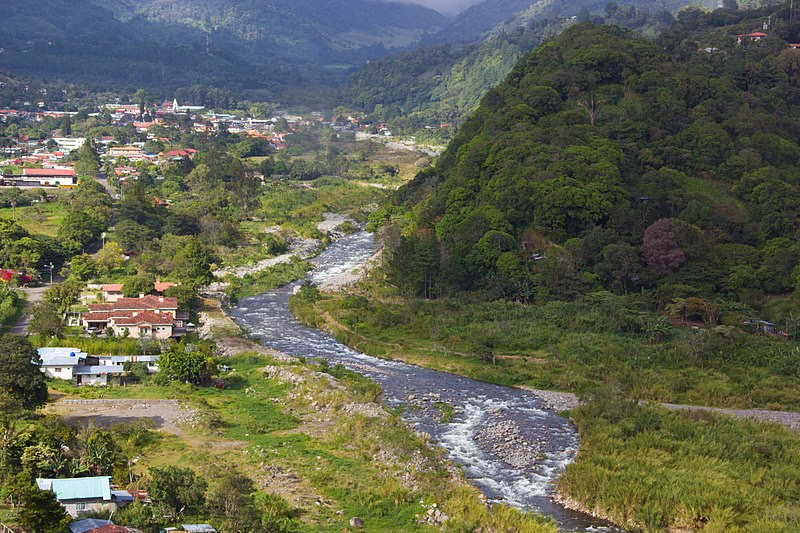
The water quality of the Caldera River is of direct concern to those who live in Boquete and downstream, not only for its environmental value, but also because it is an essential part of the environment in which we live and on which many communities depend. A study conducted by ENVIROLAB Environmental and Occupational Hygiene Laboratory, accredited by the National Accreditation Council (CNA) as accredited testing laboratory No. L-019, confirms the presence of significant fecal contamination in the river.
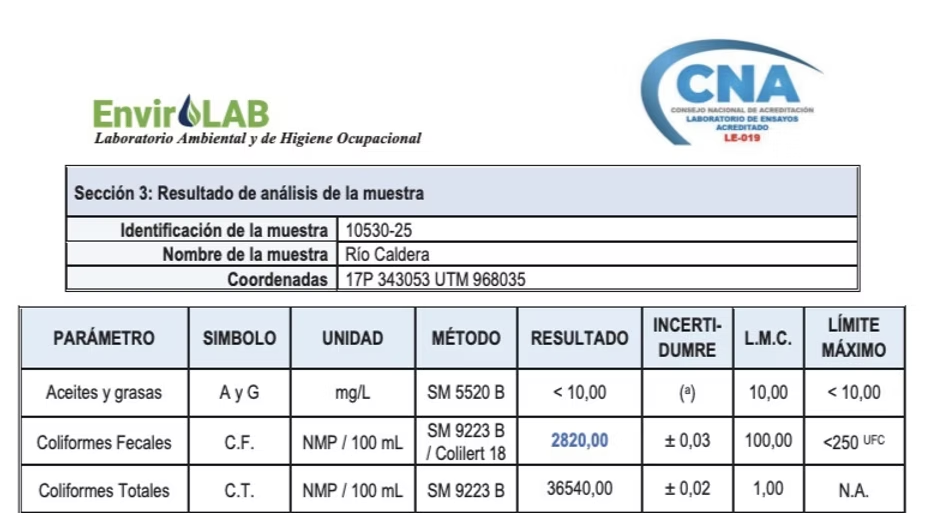
The analysis corresponds to Report No. 2025-CH-017-B663, performed on a sample from the Caldera River and analyzed between November 11 and 17, 2025, using the SM 9223 B Colilert-18 method, an internationally recognized standard method for the detection of fecal coliforms. The result obtained was 2820 MPN/100 ml of fecal coliforms. To understand the magnitude of this value, it's important to compare it with Panamanian regulations.
Executive Decree No. 75 of June 4, 2008, which establishes the primary standard for recreational use with and without direct contact, sets a maximum limit of 250 MPN/100 ml. The detected value exceeds this limit by more than eleven times, meaning that, at the sampling point, the water does not meet the conditions considered safe, even for recreational use.
Fecal coliforms are indicator bacteria of contamination by human or animal feces. Their presence confirms that the water has been impacted by fecal contamination and that it may contain other microorganisms capable of causing gastrointestinal illnesses, skin infections, or other health problems. This type of result is not an interpretation or an opinion: it is objective technical evidence that the river is receiving fecal contamination discharges.
It is important to clarify that rivers are not direct sources of drinking water and that, when their water is used for human consumption, it must undergo purification processes. However, the existence of a water treatment plant does not absolve the authorities of responsibility, nor does it eliminate the obligation of constant monitoring of the source, much less erase the environmental crime being committed against the Caldera River.
The contamination of a water source is a serious problem in itself, regardless of any subsequent treatment. For this reason, we publicly demand that the district's water utility and the mayor's office immediately present recent, verifiable, and complete microbiological analysis results of the water reaching our homes, confirming that it is safe for human consumption. This is critical for the health of Boquete residents and visitors. This is not a mere formality. It is about knowing, with certainty, what we are consuming.
We are tired of repeating, over and over again, that the Caldera River is being polluted. Tired of warning about it. Tired of pointing it out. Tired of seeing how those responsible for protecting this resource look the other way. And this is only what was measured. This test didn't even analyze for the presence of pesticides. Substances we wouldn't be surprised to find, considering we've received and documented reports of people—both civilians and institutional—applying dangerous agrochemicals near water sources. Poison that inevitably ends up in the river. Poison that inevitably ends up in our environment. We don't have to look far to see how this story ends when the authorities ignore warnings.
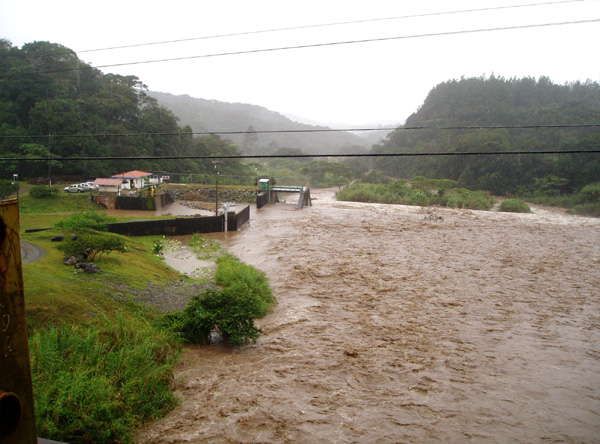
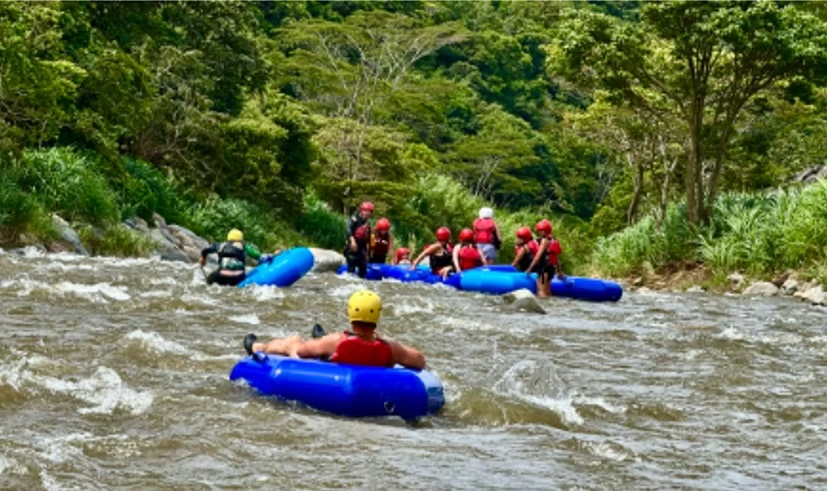
For more than twenty years, residents of the Azuero Peninsula denounced the pollution of the La Villa River pictured above. For more than twenty years, they were ignored, the problem was downplayed, and the damage was allowed to continue. It wasn't until the pollution became an undeniable public health crisis that the government finally declared a state of emergency in the provinces of Herrera and Los Santos in June 2025, allocating more than $10 million to try to repair a disaster that should never have been allowed to happen. Ten million dollars. Public money. Everyone's money. To correct decades of institutional neglect. Exactly the same pattern we are seeing today in Boquete. Exactly the same silence. Exactly the same irresponsibility.
The question is unavoidable: are we going to wait until it becomes a health crisis before we act? The current situation reflects an unacceptable level of negligence on the part of those who should be vigilant. Those who should be monitoring. Those who should be protecting. Those who should be reporting. We cannot accept that this becomes normalized. We cannot accept that it is ignored. We cannot accept that it is minimized. Because the Caldera River is not just water. It's health. It's life.
Results of the Analysis Carried Out From November 11 to 17, 2025
Retrieval-Augmented Generation (RAG) is the specific framework that allows Large Language Models (LLMs) to fetch external data before writing an answer. In my SEO consulting work, I define it as the bridge between a static AI model and a dynamic search index. This technology powers Google's AI Overviews and stops the model from hallucinating by grounding it in real facts. Unlike standard keyword-based crawling, retrieval in this context specifically refers to neural vector retrieval, which matches the semantic meaning of a query to a database of facts rather than simply matching text strings.
The process works by replacing simple keyword matching with Vector Search. When a user asks a complex question, the system does not just look for matching words. It scans a Vector Database to find conceptually related text chunks. The Retriever acts like a research assistant that pulls specific paragraphs from trusted sites and feeds them into the Generator. This means your content must be structured as clear facts that an AI can easily digest and cite. If your site contradicts the consensus found in the Knowledge Graph, the RAG system will likely ignore you.
Google uses this to create synthesized answers that often result in Zero-Click Searches. Consequently, you must optimize for entity salience and clear Subject-Predicate-Object syntax. This shift has birthed Generative Engine Optimization (GEO). My data shows that pages using valid Schema Markup are significantly more likely to be retrieved as grounding sources. You must treat your website less like a brochure and more like a structured database.
On the production side, smart SEOs use RAG to build Programmatic SEO workflows. We connect an LLM to a private database of brand facts, allowing us to generate thousands of accurate, compliant landing pages at scale without the risk of AI making things up. We are shifting from a search economy to an answer economy. To survive this shift, you must audit your data structure today. If your content is hard for a machine to parse, you will lose visibility in the AI-driven future. More on - https://www.linkedin.com/pulse/what-rag-seo-bridge-between-large-language-models-search-nicor-fdimc/
The history of search engine results page evolution charts a clear technical trajectory from a passive directory to an active answer engine. In 1998, the Google Beta interface defined the internet through the "Ten Blue Links" standard. This minimalist design relied on the PageRank algorithm to route traffic, treating the search engine strictly as a conduit rather than a destination. That architectural philosophy shifted in 2000 with the launch of Google AdWords, which monetized the right rail and established the F-shaped scanning pattern that dominated user behavior for a decade.
Universal Search in 2007 marked the first major disruption to the document-only model. By blending vertical results like video, news, and images into the organic feed, Google destroyed content silos. This integration fundamentally altered pixel real estate, pushing traditional text results below the fold and proving that users wanted mixed media. The algorithm moved beyond simple keyword matching to understanding content formats.
The semantic revolution arrived in 2012 with the Knowledge Graph. This database update allowed the engine to recognize entities as distinct objects with attributes. The resulting Knowledge Panels reduced organic click-through rates by providing instant facts, marking the beginning of the zero-click era. Mobile-First Indexing in 2018 further constrained the layout, removing the sidebar and forcing all features into a single, infinite-scrolling column.
Today, the interface has entered the predictive era with AI Overviews. Unlike Featured Snippets which extract text, these generative models synthesize novel answers from multiple sources. This evolution signifies a structural move from Information Retrieval to Information Synthesis. SEO strategy must now focus on Entity Salience to guarantee content is understood by the machine, as the SERP is no longer just a list of links but a dynamic dashboard of generated solutions. The metric of success has shifted from mere visibility to citation within the answer layer.
The Boquete Handicap Foundation has these computers and monitors for sale. All are unconditionally guaranteed for 60 days. We give discounts to Panamanian students and to charities. Email Penny at pjbarrett@aol.com or text WhatsApp 6510-8934.
DELL Latitude E7450 Laptop, 14" Screen with camera, Windows 10 Home, 256 GB Solid State Drive, 8 GB RAM, Intel i5-5300U Dual Core Quad Thread 2.30 GHz Processor, Bluetooth, 3 USB Ports, HDMI Port, New Battery -- $190
DELL Latitude E6420 Laptop, 14" Screen with Camera, Windows 10 Home, 256 GB SSD (Solid State Drive), 8GB RAM, CD/DVD, Intel i5-2520M Dual Core Quad Thread 2.50 GHz Processor, 4 USB Ports, VGA Port, HDMI, New Battery -- $225
Choosing between Cordura and Canvas Duck requires analyzing how each material fails under stress. As your fabric supplier, we knows that Cordura (Nylon 6.6) excels at resisting abrasion and water, making it the superior choice for lightweight tactical gear. Canvas Duck (Cotton), with its plied yarn construction, dominates in heat resistance and breathability, making it mandatory for welders and industrial workwear.
Cordura is an air-jet textured nylon filament designed to slide. In laboratory Wyzenbeek abrasion testing, our 1000 Denier Nylon withstands over 300,000 double rubs. The synthetic filaments refuse to break under friction, whereas natural fibers eventually grind away. This makes nylon the correct specification for motorcycle skid zones or backpack bases. However, this strength comes with a thermal weakness. Nylon is a thermoplastic that melts at approximately 255°C. If you expose it to welding slag or a campfire, it melts and fuses to skin.
Canvas Duck is mechanically distinct from standard canvas due to its 2x2 plied yarn weave. This dense structure, found in our Number 1 Heavyweight Duck, resists punctures and snags better than looser weaves. Critically, cotton is cellulosic. It chars at high heat but never melts. This thermal safety profile is why industrial tradesmen rely on duck cloth. For weather protection, untreated cotton absorbs water, but applying wax transforms it. Our Waxed Canvas Army Duck offers excellent water repellency while developing a rich patina that synthetic 500 Denier Cordura cannot replicate. Synthetics often suffer from hydrolysis and coating failure after a decade, whereas cotton softens and improves with age. If your new gear feels too rigid, our guide on how to soften stiff duck cloth explains how to break it in quickly.